
Redefining FMCG Distribution Through Mathematical Optimization
Blending high-fidelity simulation with custom algorithms to maximize warehouse throughput and eliminate operational bottlenecks before a single brick is laid.
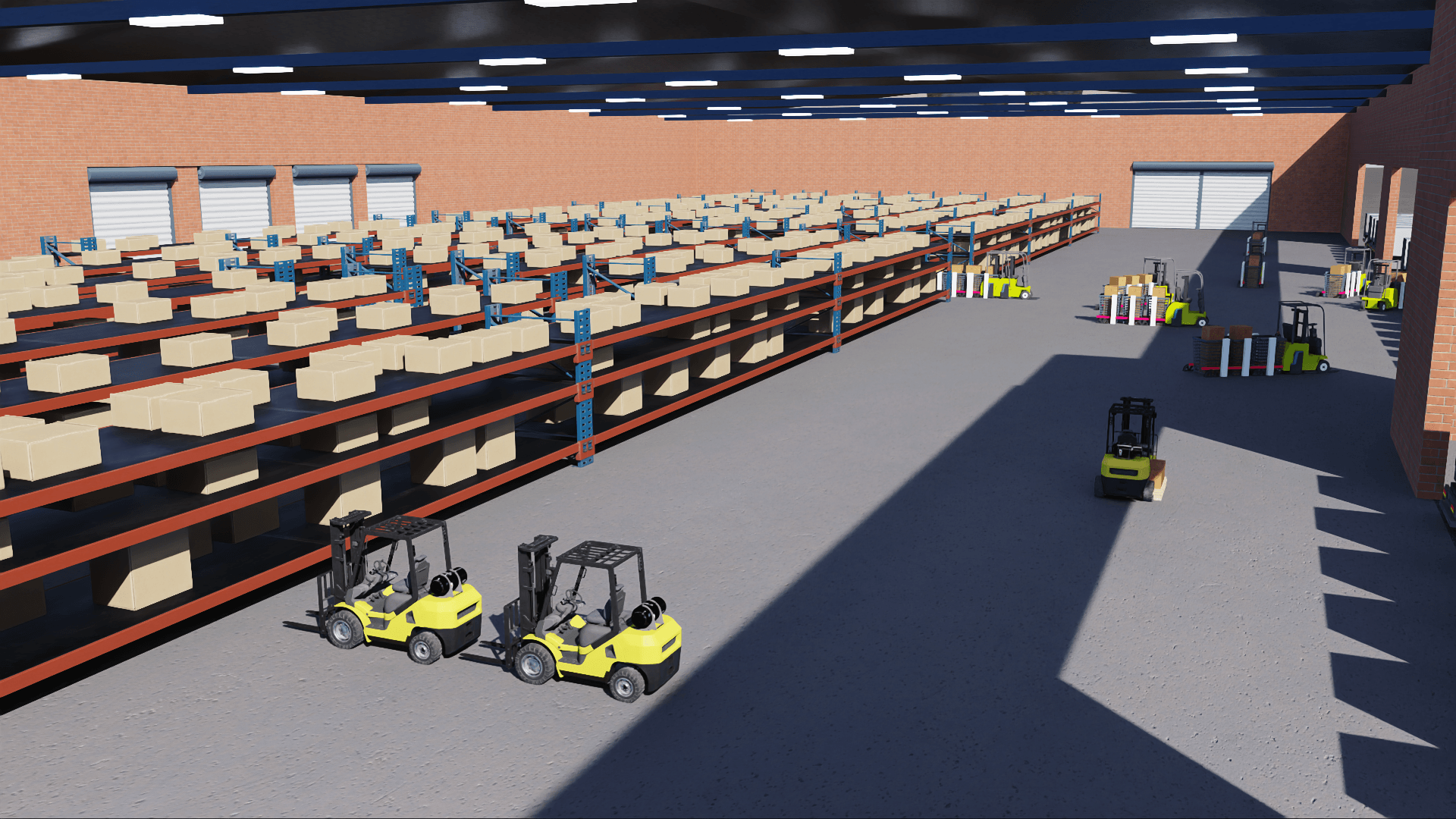
Engineering High-Velocity Distribution Hubs for Sustained Growth
This project transformed a traditional FMCG distribution model into a high-efficiency logistical powerhouse. By integrating custom mathematical algorithms with advanced discrete-event simulation, we eliminated the guesswork from warehouse design. The result was a precision-engineered layout where every square meter is optimized for flow, ensuring the facility can handle peak-demand surges without congestion or performance drops.
Our approach went beyond a one-time design; we delivered a reusable optimization tool that empowers the client to scale. By aligning with our “People-First Digitalization” strategy, the final solution simplifies complex decision-making for managers while creating a more intuitive, less stressful environment for warehouse operators.
Challenges · Solution · Results
- Design Uncertainty: Critical lack of data-driven insights regarding the ideal aisle configuration, dock placement, and facility dimensions.
- Throughput Conflicts: Difficulty balancing the need for high-density storage with the requirement for rapid picking and loading speeds.
- Static Planning: Traditional planning methods failed to account for real-world operational variables like equipment congestion and peak-hour bottlenecks.
- Mathematical Modeling: Utilized GAMS and Python to run thousands of permutations to find the mathematically optimal layout for space efficiency.
- EBI Sim Validation: Built a high-fidelity simulation to test "what-if" scenarios, visualizing the impact of different designs on real-time KPIs.
- Dynamic Dashboards: Developed a user-friendly interface for scenario comparison, allowing stakeholders to see the cost-benefit ratio of each layout option.
- Optimized Performance: Selection of a scalable warehouse layout that maximizes picking efficiency and minimizes loading times.
- CAPEX Certainty: Provided a standardized design methodology that can be reused for all future warehouse expansion projects.
- Reduced Operational Costs: Lowered long-term labor and energy costs by streamlining travel paths and improving space density.
In-Depth Documentation
Strategic Vision & Operational Alignment
In the fast-moving consumer goods (FMCG) sector, the warehouse is the heart of the supply chain. The client faced the challenge of designing a facility that could grow with their business without incurring the massive overhead of poorly utilized space. Our primary goal was to bridge the gap between architectural design and operational reality. By applying the EBI Sim pillar of our platform, we focused on “Design Simulation & Optimization,” ensuring that the management team had a risk-free digital sandbox to pressure-test their logistics strategy before committing to physical infrastructure.
The EBI Sim Methodology
The implementation followed a rigorous hybrid workflow. First, we employed GAMS and Python-based optimization to solve for the best theoretical facility dimensions and dock locations. Once the optimal mathematical framework was established, we moved into the AnyLogic simulation environment. This allowed us to observe the “living” warehouse—simulating how operators move, how forklifts interact in aisles, and where congestion forms during peak hours. This two-step process ensured that the final layout wasn’t just efficient on paper, but also ergonomic and practical for the workforce on the ground.
Tools & Technologies
Explore More Projects

Transform Industrial Sales with EBI TWIN+ Interactive Showrooms
Bridge the gap between engineering and sales with an immersive 3D environment that allows clients to customize complex assets in real-time, reducing the need for physical prototypes.
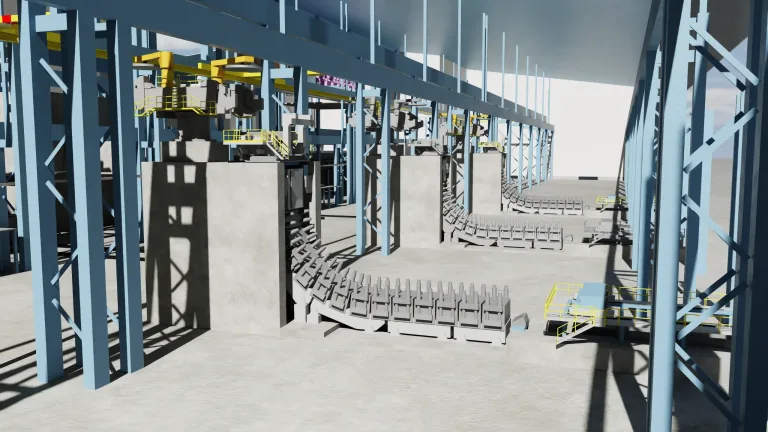
Synchronizing Steel: AI-Driven Scheduling for Next-Gen Meltshops
Transforming complex EAF-CCM interactions into seamless, automated production flows with real-time digital twin simulation and predictive analytics.
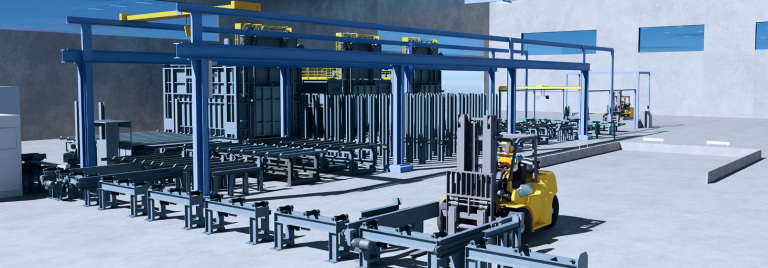
Scaling Industrial Output Through Dynamic Engineering Validation
De-risking capacity expansion by simulating material flow, equipment utilization, and real-world operational scenarios before the first brick is laid.
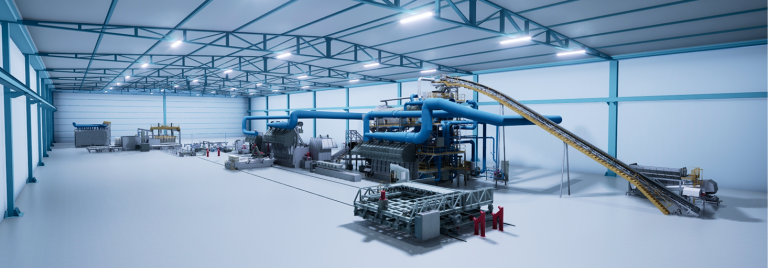
Revolutionizing Aluminum Recycling with Interactive Digital Twins
Bridging the gap between complex metallurgical engineering and intuitive 3D exploration to accelerate sales and optimize plant design.
Ready to discuss your project?
Let's explore how advanced strategies and solutions can elevate your business.
Get in Touch →Explore more projects
See how we've applied these methods across logistics, manufacturing, and beyond.
View All Projects →