The global steel industry stands at a critical juncture in 2026. Responsible for 7% to 10% of total global carbon dioxide emissions—releasing between 2,400 and 2,713 million tonnes of CO2 annually—primary steelmaking is under unprecedented pressure from tightening climate mandates and volatile energy markets. The conventional blast furnace–basic oxygen furnace (BF-BOF) route continues to dominate global output at roughly 72%, consuming 500 kilograms of metallurgical coal and emitting 1.9 to 2.2 tonnes of CO2 per tonne of crude steel. As the European Union’s Carbon Border Adjustment Mechanism (CBAM) enters its full operational phase, imposing 20% to 35% cost increases on high-carbon imports, industrial plant managers and P&L owners face severe financial penalties. While secondary steelmaking via electric arc furnaces (EAF) using scrap offers lower carbon intensity (0.4 to 0.8 t CO2/t steel), physical scrap limits and tramp element contamination prevent scrap-only EAFs from meeting high-grade automotive and engineering specifications. Consequently, primary steel decarbonization is no longer an optional ESG initiative—it is a core operational requirement for survival.
The H2-DRI-EAF Bottleneck: Thermal, Energy, and Carburization Deficits
The most widely discussed pathway for deep decarbonization is hydrogen direct reduction paired with electric arc furnaces (H2-DRI-EAF). Replacing carbon-heavy blast furnaces with vertical shaft furnaces allows hydrogen gas to strip oxygen from iron ore pellets, releasing water vapor instead of carbon dioxide. However, transitioning from fossil-based reduction to 100% green hydrogen introduces severe thermodynamic and capital barriers. Unlike exothermic carbon monoxide reduction, hydrogen-based reduction is highly endothermic, requiring massive continuous thermal energy preheating. Producing one tonne of crude steel via H2-DRI-EAF consumes 8.25 GJ of hydrogen energy and 2.06 GJ of direct power, requiring a staggering 10 to 14 gigawatts of upstream renewable generation capacity for a single 5 million tonnes per annum (Mtpa) steelworks. As detailed in our analysis of sustainable manufacturing practices in 2026, unvalidated energy infrastructure investments carry immense stranded-asset risks.
Furthermore, pure H2-DRI presents a severe carburization deficit. Blast furnace pig iron contains 4% to 4.5% dissolved carbon, which acts as an essential chemical energy source for downstream melting. Pure H2-DRI contains virtually zero carbon, impairing EAF melting dynamics, preventing foaming slag formation required to shield refractories, and increasing gas defect risks. While introducing external biocarbons offers a potential solution, biomass fragility, high moisture content, and logistics costs severely limit immediate scale-up. The financial impact of these constraints was underscored in March 2026 when Cleveland-Cliffs abandoned its $500 million federal grant and cancelled the green steel conversion at its Middletown Works facility, citing regional green hydrogen deficits and an estimated $1.1 billion private CapEx risk without guaranteed green premiums. Instead, the facility pivoted to AI-driven process optimization on its existing blast furnace to capture incremental energy savings.
The Pilbara Problem: DR-Grade Ore Scarcity and Hybrid ESF Pathways
Beyond energy infrastructure, the global transition to H2-DRI-EAF is fundamentally constrained by a raw material bottleneck: the scarcity of Direct Reduction (DR)-grade iron ore. Traditional shaft furnaces demand ultra-high-grade pellets with at least 66% to 67% iron content and combined silica and alumina impurities below 3.5%. DR-grade ore accounts for less than 5% of global iron ore production. This scarcity creates the “Pilbara Problem” in Australia, where dominant hematite ores average 55% to 62% iron content. When processed in shaft furnaces, these lower-grade ores undergo thermal dehydration, creating micro-porosity that causes pellets to disintegrate into dust under the column load, choking gas flow and halting reduction reactions. Managing these raw material and logistics constraints requires real-time coordination across supply networks, similar to the strategies explored in our research on the agentic AI supply chain.

To bypass this ore quality wall, steelmakers are deploying alternative technological realignments. Integrating Electric Smelting Furnaces (ESFs) between the DRI shaft furnace and basic oxygen converters allows facilities to process low-grade, high-gangue DRI under reducing atmospheres. The molten electric hot metal can then be refined in existing BOF converters, achieving 40% to 50% emissions reductions with natural gas, or up to 90%+ with green hydrogen. Simultaneously, direct electrification technologies are emerging to eliminate hydrogen dependencies entirely. Boston Metal’s Molten Oxide Electrolysis (MOE)—operating at 1600°C using inert iridium anodes—and Electra’s low-temperature electrowinning (operating at 60°C to leach low-grade ores in acid before electrodepositing 99.9%+ pure iron) represent long-term pathways. Electra’s zero-thermal-inertia process allows direct power matching with intermittent wind and solar, backed by commercial agreements with Nucor, Toyota Tsusho, and POSCO targeting commercial deployment by 2029.
Policy Divergence and Greenium Economics: EU CBAM vs. U.S. Protectionism
The commercial landscape for green steel in 2026 is split by stark geopolitical and regulatory divergence. In Europe, the full implementation of CBAM and proposed EU Emissions Trading System (ETS) reforms—including an annual Linear Reduction Factor of 3.7% (2031–2035) and a €100 billion Industrial Decarbonisation Bank—force steelmakers to internalize carbon costs. In contrast, the United States has pivoted toward trade protectionism, raising Section 232 steel tariffs to 50% while rescinding federal “Buy Clean” procurement mandates (Executive Order 14057). This insulates domestic U.S. producers from foreign overcapacity, allowing mills to prioritize short-term profit margins over capital-intensive long-term decarbonization investments.
These policy dynamics govern the “Greenium”—the green price premium buyers pay over standard hot-rolled coil (HRC). European flat steel with certified low carbon intensity demands premiums of €120 to €200 per tonne (and up to €350/t for long-term automotive contracts), driven by OEM scope 3 targets from Mercedes-Benz, BMW, and Volvo. However, spot market premiums remain modest (€80–100/t). Stegra (formerly H2 Green Steel) in Sweden established the global benchmark for bankability, securing over €6.5 billion in funding by pre-selling 50% of its initial 2.5 Mtpa capacity through binding off-take contracts. Standard interoperability initiatives, such as ResponsibleSteel’s V2.1.1 standard alignment with Europe’s LESS framework and the China Iron and Steel Association (CISA), are stabilizing green steel accounting across 60% of global production.
De-Risking Steel Decarbonization with AlsanX Digital Twins
Whether evaluating hybrid DRI-ESF-BOF layouts, introducing biocarbon feeds, or optimizing EAF furnace tap-to-tap cycles, making physical modifications on a live meltshop floor introduces unacceptable financial and operational risk. Static engineering models fail to account for dynamic feedback loops between discrete melting, continuous casting, and overhead crane logistics. AlsanX eliminates this CapEx uncertainty by constructing high-fidelity Digital Twins powered by AnyLogic process simulation, NVIDIA Omniverse 3D visualization, and AI analytics engines.
As demonstrated in our published case study on steel production digital twins and our educational webinar on process simulation and operator training, AlsanX allows steelmakers to model heat loss, scrap charging schedules, and internal logistics in a consequence-free virtual environment before committing capital expenditure. For deeper insights into raw material routing and yard logistics, explore our analysis of agentic AI logistics ROI.
Executive Action Plan for Plant Directors and P&L Owners
To successfully navigate steel decarbonization in 2026 without exposing operating margins to unhedged risks, operations leaders should execute a structured three-step roadmap:
First, conduct a dynamic capacity and material audit to map your facility’s exact sensitivity to ore grade degradation, scrap impurity accumulation, and energy tariff volatility. Second, validate hybrid process layouts—such as gas-based DRI-ESF transitions or thermal energy recovery systems—using dynamic simulation before placing equipment orders. Third, deploy immersive digital twin training to prepare operators for complex EAF chemistry and furnace handling prior to plant commissioning.
Project Brief
Download the project overview.
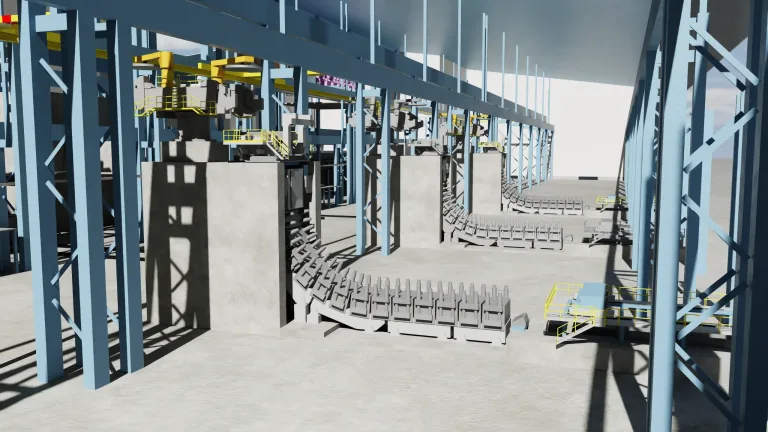
Synchronizing Steel: AI-Driven Scheduling for Next-Gen Meltshops
Transforming complex EAF-CCM interactions into seamless, automated production flows with real-time digital twin simulation and predictive analytics.
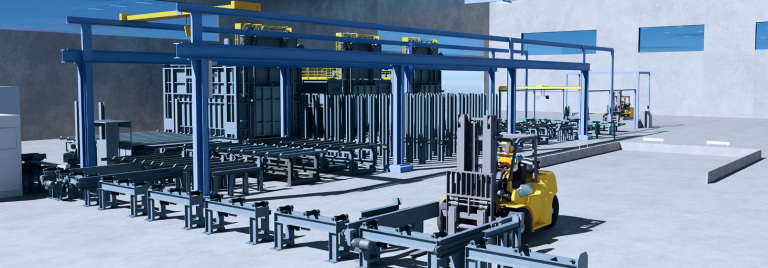
Scaling Industrial Output Through Dynamic Engineering Validation
De-risking capacity expansion by simulating material flow, equipment utilization, and real-world operational scenarios before the first brick is laid.