How Digital Twins Cut Manufacturing Costs and De-risk Decisions
Introduction
In competitive manufacturing, uncertainty is a silent profit killer. Hidden bottlenecks, variable yields, unplanned downtime, and supply chain shocks all erode margins. What if you could explore changes ahead of time—virtually—and see results before touching the physical equipment?
That’s the promise of a digital twin. A digital twin is a virtual replica of a physical system (a machine, line, plant, or even full supply chain), connected in real time to data flows, capable of simulating “what-if” changes, predicting behavior, and optimizing outcomes. At Emaablue, we build these digital twins specifically for manufacturers—turning uncertainty into clear, data-driven actions.
What Is a Digital Twin — In Depth
Definition & key components
- A digital twin isn’t just a static model. It integrates real-time data, behavioural models, and visualization/analytics layers so the virtual copy evolves in tandem with the physical system.
- There are multiple types of twins:
- Product twin – mirrors a single device or component’s behavior throughout its lifecycle
- Process (or system) twin – simulates interactions across machines, lines, and workflows
- Supply chain twin – models flows, inventory, logistics etc across nodes
Companies often combine them.
Enabling technologies
To make a digital twin work, you need:
- Sensors / IoT infrastructure + data acquisition
- Data pipelines & integration, clean and consistent
- Physics / statistical / machine learning models
- Real-time or near-real-time analytics and simulation engines
- Interfaces / visualization & decision support tools
Digital twin vs traditional simulation
While classical simulation is useful, it typically works in “offline” or “what-if” modes. A twin is “live” — it continuously updates and can feed into decision loops. That difference enables closed-loop optimization, not just one-time insights.
What Digital Twin Deliver
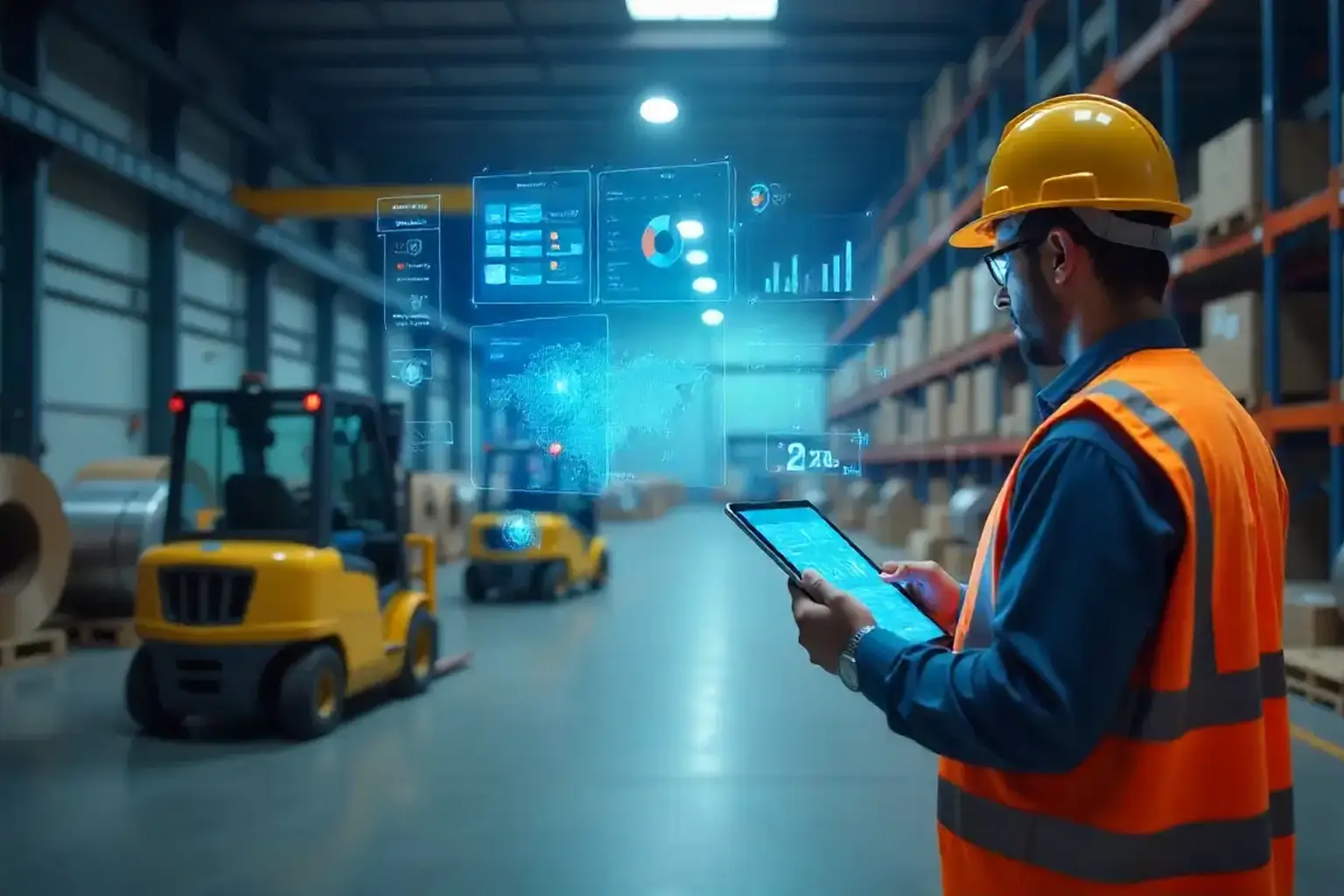
A digital twin continuously merges real-time plant data with simulation and optimization models. This enables leaders to:
- Monitor performance in real time
- Run what-if experiments safely
- Predict outcomes of operational changes
Unlike static models, Emaablue’s twins evolve alongside your plant—providing living decision support that reflects actual shop-floor dynamics.
Cost Reduction & Risk Mitigation: Mechanisms & Evidence
Here’s how digital twins contribute to cost savings and risk reduction in manufacturing environments, backed by literature and case evidence.
Key mechanisms of cost savings
| Mechanism | How it saves cost | Supporting evidence / example |
| Reduced physical trials / prototyping | By modeling and testing virtually, you avoid repeated physical setups, scrap, and downtime. | Digital twins shorten development & validation cycles; McKinsey notes up to 50% reduction in time to market using twin tools. |
| Process optimization & throughput gains | Simulating line balances, machine sequencing, buffer sizes, and resource allocation to find optimal settings. | Many manufacturers applying twins reduce operational costs by 20–30% in targeted domains. |
| Reduced downtime / improved maintenance | Predict failures, schedule maintenance proactively, avoid spoilage. | One leading digital twin vendor claimed cost reductions of 3–6% in procurement and up to 10% in transport & labour when twin strategies are applied. |
| Inventory & logistics cost reduction | Test inventory policies, logistics flows, supply chain changes virtually before implementation. | McKinsey reports digital twins can reduce transport & labor costs by ~10%, improve delivery reliability by ~20%.
|
| Energy / resource optimization | Adjust setpoints, usage schedules, resource distribution based on optimization runs. | Research work on energy-aware twins in batch processing shows runtime control improvements. |
Risk mitigation & decision confidence
- “What-if” scenario stress testing — simulate demand shock, machine failure, supply disruption and see how the system responds.
- Sensitivity & margin analysis — find parameters your system is most vulnerable to, and set safe zones.
- Faster decision cycles — reduction of “waiting for data” or “running trial runs.”
- Better strategic investment decisions — use ROI modeling to pick which lines, where to expand, or where to automate.
The NIST “Economics of Digital Twins” report (2024) estimates that across manufacturing, if fully adopted, digital twins may generate ~ $37.9 billion in benefits annually (with a 90% confidence interval of $16.1B to $38.6B), depending on assumptions.
However, the report cautions: ROI depends heavily on complexity of the system and cost consequences of non-optimal settings — in simpler systems, benefits may not justify the investment.
Also, a study “Cost Benefit Analysis for Digital Twin Model Selection” shows that choosing the right level of modeling (complex vs simplified) is critical to maximize benefits.
When Does It Make Sense? (Feasibility & Decision Framework)
Not every system needs a full twin. Use this decision framework to judge:
Key criteria to consider
- System complexity & coupling — if many interacting parts, non-linear behavior, or strong dependencies, twin returns tend to be higher.
- Cost of failure / deviation — high scrap, rework, downtime increases benefits.
- Data readiness — existing sensors, clean data streams, historical data.
- Organizational readiness & maturity — ability to act on twin outputs, change policies, alignment between operations & data science.
- Pilotability / modular approach — ability to start small and scale.
Investment lifecycle & phasing
Many organizations adopt a phased approach:
- Scoping & value case — pick one critical domain (e.g. bottleneck line, logistics link).
- Baseline modeling / digital twin prototype — start lightweight and validate predictions vs reality.
- Closed-loop integration — connect twin insights to controllers or decision rules.
- Scale & govern — expand twin scope, integrate with broader systems (ERP, MES, SCM).
From the NIST report: use net present value (NPV), sensitivity / Monte Carlo simulations, and internal rate of return (IRR) over multiple scenarios in the business case.
How Emaablue Helps: From Strategy to Deployment
At Emaablue, we support organizations throughout their digital twin journey—from initial strategy to full deployment. Our services can be summarized in five key areas:
Design & Integration
We help companies structure and organize their existing data and connect it into a practical digital twin. The goal is to design a model that is accurate and useful, without adding unnecessary complexity
Simulation & Optimization
With the twin in place, we run different scenarios to test possible strategies and identify the best path forward. This enables leaders to make decisions with more confidence and lower risk.
Decision Support
A digital twin isn’t just a virtual model—it actively supports decision-making. It can suggest improvements that can be applied directly to operations, helping managers act faster and with greater certainty.
Business Case & Scaling
From the beginning, we emphasize a clear view of return on investment (ROI). Once a pilot proves successful, we help expand and scale the twin across the wider organization.
Industrial Expertise
Unlike generic software providers, Emaablue brings industry-specific know-how. Our models are built with real operational constraints, safety standards, and regulatory requirements in mind.
Challenges & Best Practices
Launching a digital twin is not without challenges. Based on our experience, here are common pitfalls and how we help clients overcome them:
- Overcomplexity → Start simple, build in steps, and expand gradually.
- Data quality issues → Strong results depend on reliable data; cleaning and standardization are essential.
- Organizational resistance → Involve stakeholders early and demonstrate quick, visible wins.
- Model drift → Keep the twin updated so it always reflects the real system.
- Data security → Protect industrial data with strong access controls and cybersecurity measures.
Conclusion
Digital twins represent a strategic lever, not just a technical novelty. When applied thoughtfully, they can:
- Reduce manufacturing and logistic costs
- De-risk investment decisions
- Accelerate time-to-value
- Improve resilience in volatile environments
But success depends on matching model scope, data readiness, and organizational alignment.
If you’re curious how a digital twin might impact your specific process or bottleneck, Emaablue is ready to walk you through a pilot roadmap, prototype twin, and cost-benefit analysis. Let’s schedule a discovery call — we’ll analyze your top challenge, run scenarios, and show expected ROI before you commit.