
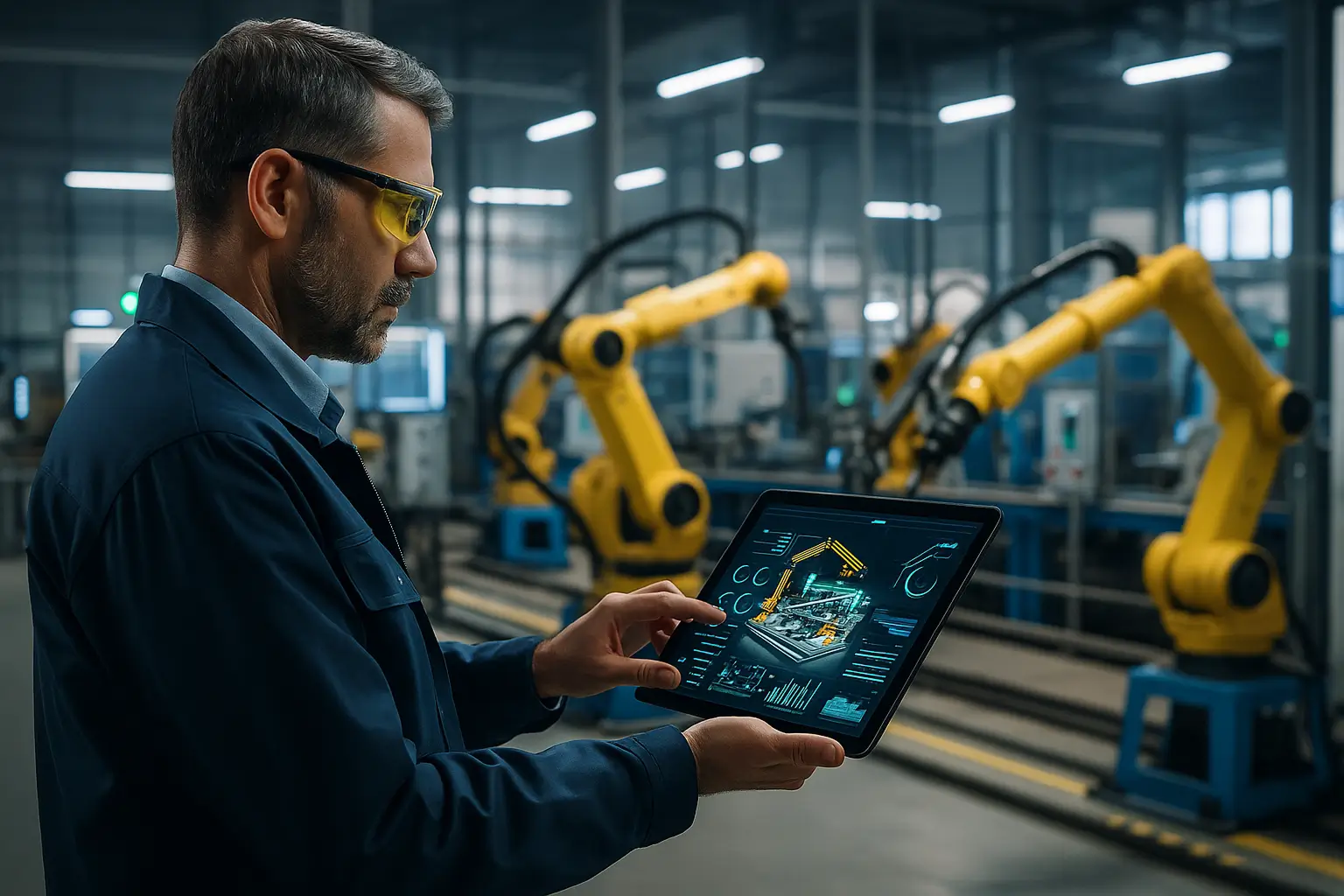
Digital Transformation in Manufacturing: From Necessity to Operating Model
Introduction
The term digital transformation has become one of the most used—and sometimes misused—concepts in industry. For years, many manufacturers treated it as a “nice-to-have” or a long-term aspiration. But in today’s competitive landscape, digital transformation is no longer optional—it is a survival strategy.
Global reports from McKinsey (2023), BCG (2024), and Deloitte (2024) highlight the same reality: manufacturers who fail to adopt digital technologies risk losing efficiency, resilience, and market share. At the same time, success stories show how companies that deploy digital twins, AI, IoT, and data-driven operating models achieve significant cost reductions, agility, and customer satisfaction.
At Emaablue, we help manufacturers move beyond buzzwords by building practical operating models for digital transformation—linking strategy, data, and operations into measurable business outcomes.
Why Digital Transformation Is No Longer Optional
Several global trends make digital transformation a necessity, not a choice:
- Market volatility – Demand fluctuations, supply chain shocks, and geopolitical risks require agile responses.
- Sustainability pressures – Governments and customers demand lower emissions and energy efficiency.
- Technology acceleration – AI, automation, and cloud adoption are advancing at unprecedented speed.
- Workforce evolution – Younger, digitally fluent employees expect modern tools and transparent data access.
A 2024 BCG report showed that companies who lead in digital adoption are 2.5x more likely to achieve above-average revenue growth compared to laggards. Similarly, Deloitte’s 2024 Global Manufacturing Survey found that over 70% of executives see digital transformation as the top driver of long-term competitiveness.
Emaablue supports manufacturers in turning these challenges into opportunities by aligning technology adoption with business goals.
The Five Pillars of a Successful Digital Transformation Operating Model
Based on recent research (McKinsey 2023, MIT Sloan Review 2024), effective digital transformation requires more than technology investment—it needs a structured operating model.
Clear Strategy and Vision
- Transformation efforts must be tied directly to business objectives: efficiency, sustainability, or market growth.
- Companies that treat digital projects as isolated pilots often fail; leaders need an integrated roadmap.
At Emaablue, we co-create digital roadmaps with clients, ensuring alignment between corporate strategy and operational initiatives.
Data as a Core Asset
- “Data is the new oil” is no longer just a metaphor. Reliable, structured, and governed data is the foundation of digital transformation.
- IDC’s 2024 report shows that 60% of failed digital initiatives trace back to poor data management.
Emaablue helps organizations build strong data foundations—from IoT pipelines to governance frameworks—making data usable and trustworthy.
Technology Building Blocks
The essential enablers of transformation include:
- IoT and connectivity – sensors, edge computing
- AI and advanced analytics – predictive models, optimization
- Digital twins – simulation-based decision-making
- Cloud and platform integration – scalability and flexibility
People and Culture
- Digital transformation is 30% technology and 70% people, according to MIT (2024).
- Without cultural change, employee training, and leadership commitment, even the best technologies fail.
Emaablue emphasizes stakeholder engagement, operator training, and change management in every transformation project.
Governance and Value Tracking
- Success requires metrics: ROI, uptime, energy savings, and customer satisfaction.
- Governance structures must ensure accountability and continuous improvement.
Want to build your own transformation model? [Book Emaablue’s 90-minute strategy workshop].
Lessons from Recent Studies
Several 2023–2024 case studies provide concrete evidence:
- Automotive manufacturing – A European OEM achieved 15% productivity gains by integrating AI-based scheduling with digital twins (McKinsey, 2023).
- Steel industry – Plants adopting IoT-driven energy management systems cut energy costs by up to 12% (Deloitte, 2024).
- Consumer goods – Companies with AI-driven supply chain twins improved delivery reliability by 20% (BCG, 2024).
These results underscore the fact that digital transformation is measurable and real—when done right.
Emaablue brings similar approaches to its clients, focusing on manufacturing, logistics, and energy-intensive industries.
Common Pitfalls in Digital Transformation
Even though the benefits are clear, research shows that 70% of digital transformation projects still fail to deliver expected value (MIT Sloan, 2024). Why?
- Lack of strategic clarity – treating digital as an IT project rather than a business transformation.
- Siloed pilots – isolated experiments that never scale.
- Weak data governance – poor data leads to poor insights.
- Cultural resistance – employees unwilling to change workflows.
- No ROI tracking – transformation becomes a cost center, not a value generator.
Emaablue helps clients avoid these pitfalls by embedding business cases, governance, and cultural readiness into every project.
How Emaablue Supports Digital Transformation
At Emaablue, we follow a structured, practical approach:
- Strategy to sprint – Co-developing a roadmap aligned to business objectives.
- Build and scale – Implementing digital twins, AI applications, and AR/VR training systems.
- Capability transfer – Training teams, documenting processes, and ensuring clients own the solutions long term.
- Value dashboards – Monitoring KPIs like energy use, downtime, and ROI continuously.
The Future of Digital Transformation in Manufacturing
Looking ahead, several trends will shape the next wave:
- Hyperconnected supply chains – End-to-end visibility with AI and blockchain.
- Sustainable digital twins – Optimizing for energy, emissions, and circular economy goals.
- Generative AI – Assisting engineers in design, scheduling, and optimization tasks.
- Human-technology collaboration – AR/VR and cobots enhancing workforce productivity.
Emaablue is already exploring these frontiers, ensuring clients are future-proof in both operations and competitiveness.
Conclusion & Call to Action
Digital transformation is no longer a buzzword or a distant vision. It is the operating model of the future, and companies that fail to adapt risk being left behind.
The formula is clear:
- Define a strategic vision
- Build a solid data foundation
- Deploy enabling technologies
- Engage people and culture
- Track ROI with discipline
At Emaablue, we bring together technology, industry expertise, and change management to help manufacturers succeed in this journey.