Predictive Maintenance with AI: From Unplanned Downtime to Planned Advantage
Introduction
In modern manufacturing, few challenges are as costly and disruptive as unplanned downtime. When a critical machine suddenly fails, the ripple effects can be devastating: production halts, delivery commitments are missed, and labor costs skyrocket. According to multiple industry studies, downtime costs large manufacturers millions of dollars every year.
For decades, the standard defense has been preventive maintenance—replacing parts on a fixed schedule. While this reduces catastrophic breakdowns, it often leads to wasted resources. Components are replaced too early, maintenance teams are overworked, and companies still suffer unexpected failures.
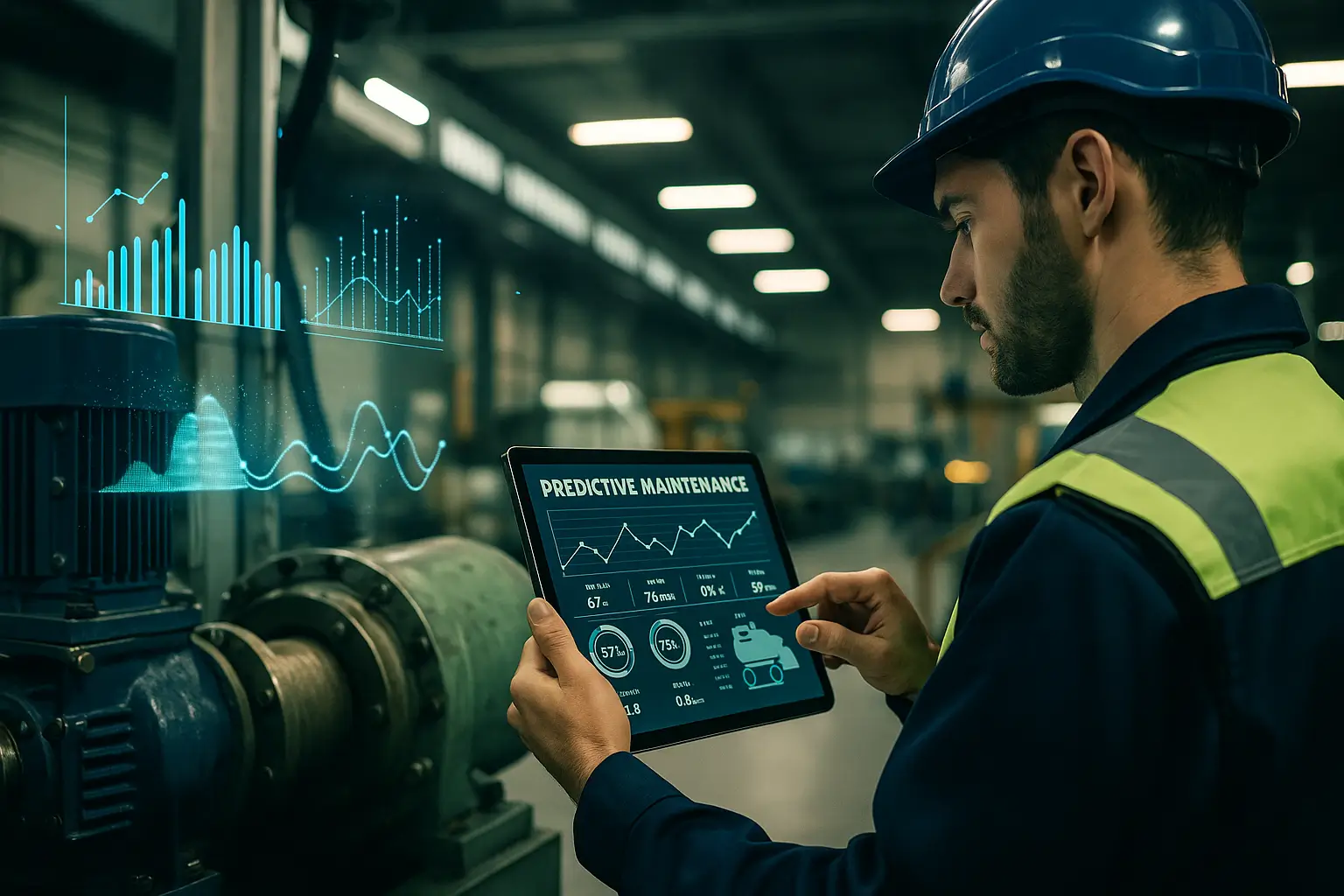
The solution is smarter, data-driven, and proactive: AI-powered predictive maintenance (PdM). Instead of guessing when assets might fail, predictive maintenance uses sensors, machine learning, and digital twins to forecast failures in advance—so action can be taken at exactly the right time.
At Emaablue, we help manufacturers integrate predictive maintenance strategies into their operations, combining AI insights with industrial know-how to create systems that are both reliable and practical.
What Predictive Maintenance Really Means
Predictive maintenance is often misunderstood as simply monitoring machine data. In reality, it is a comprehensive framework built around three layers:
- Data acquisition – Sensors collect data from assets (vibration, temperature, noise, electrical signals, usage cycles).
- Analytics and AI models – Algorithms detect anomalies, patterns, and early warning signs of failure.
- Decision support – Predictions are translated into maintenance actions: alerts, work orders, or integration with ERP/EAM systems.
The real strength lies in connecting these layers into a continuous improvement loop. Each cycle of maintenance adds new data, which retrains models, improving accuracy over time.
The Business Value of AI Predictive Maintenance
Reduced downtime
By predicting failures days or even weeks in advance, PdM enables maintenance teams to intervene before breakdowns happen.
- Studies report 20–30% reduction in downtime for organizations that adopt predictive strategies.
- Less downtime means higher throughput, more reliable deliveries, and stronger customer trust.
Lower maintenance costs
Instead of replacing parts too soon, assets are serviced only when needed. This cuts spare parts costs, reduces overtime, and minimizes unnecessary interventions. Some analyses estimate 25% savings on maintenance expenses with AI-driven PdM.
Extended equipment life
With optimized interventions, assets last longer. This defers expensive capital investments and reduces total cost of ownership.
Emaablue helps clients quantify these benefits by embedding ROI dashboards into their predictive systems—making cost savings visible in real time.
Implementation Roadmap
Predictive maintenance is not a “plug-and-play” solution; it requires structured deployment. A typical roadmap includes:
- Identify critical assets – Focus first on machines where failures are most costly.
- Establish data foundation – Ensure sensors are calibrated, data is clean, and historical logs are available.
- Model training & validation – Build AI models that can detect anomalies and forecast failures with trusted lead times.
- Integrate into operations – Connect predictions to dashboards, generate alerts, or even automate work orders.
- Scale and improve – Expand from one asset to full production lines, continuously retraining models.
At Emaablue, we guide clients through each step, from pilot projects to enterprise-scale rollouts.
Common Challenges and How to Overcome Them
While predictive maintenance offers significant benefits, it comes with challenges that must be addressed:
- Data quality issues – Incomplete or noisy data reduces accuracy. Solution: start with targeted assets and build robust pipelines.
- Trust in AI – Operators may hesitate to act on algorithm outputs. Solution: use interpretable models and transparent dashboards.
- Change management – Shifting from reactive to predictive requires cultural change. Solution: show early wins and engage teams from the start.
- Scalability – Many projects succeed as pilots but fail to expand. Solution: design scalable architectures from day one.
- Model drift – Machine behavior changes over time. Solution: retrain models regularly and set up monitoring.
Emaablue addresses these challenges by blending industrial expertise with data science, ensuring PdM solutions deliver real-world value—not just lab results.
How Emaablue Makes Predictive Maintenance Practical
At Emaablue, our approach to predictive maintenance is built on four principles:
- Industrial-first design – Models are grounded in real process knowledge, not just generic algorithms.
- Integration-ready architecture – Solutions connect seamlessly with ERP, MES, and EAM systems.
- ROI-focused pilots – Every project starts with a clear business case and measurable outcomes.
- Continuous support – We provide model retraining, system updates, and long-term governance.
The Future of Predictive Maintenance
The evolution of predictive maintenance goes beyond simple AI models. The next wave includes:
- Integration with digital twins – Simulating not only failures but also the operational impact of downtime.
- Edge AI deployment – Running models directly on machines for faster, real-time response.
- Hybrid models – Combining physics-based and AI-driven approaches for greater accuracy.
- Cross-factory learning – Leveraging data across multiple sites to build stronger models.
Emaablue is already working with clients to integrate predictive maintenance into digital twin frameworks—closing the loop between simulation, prediction, and decision-making.
Conclusion
Unplanned downtime doesn’t just reduce productivity—it erodes trust, increases costs, and undermines competitiveness. AI-powered predictive maintenance offers a practical path to reduce risks, optimize resources, and extend asset life.
At Emaablue, we bring together AI technology and industrial expertise to help manufacturers move from reactive firefighting to proactive planning.