The industrial landscape is undergoing a profound shift. What was once the domain of manual checks and slow, laborious processes is now being revolutionized by artificial intelligence (AI) and machine vision. In high-stakes manufacturing sectors like steel and aluminum, where the smallest flaw can have massive consequences, these technologies are moving from a futuristic buzzword to a practical, transformative solution led by innovators such as Emaa Blue.
By automating defect detection, AI is closing the gap between the limits of human endurance and the accelerating demand for perfect, high-quality materials. This shift is building a new generation of “smart factories” defined by greater speed, unparalleled accuracy, and far fewer errors—powered in part by simulation platforms and digital modeling tools enabled through AnyLogic License.
Why Flawless Steel is Non-Negotiable
Surface defects in metal products are far more than just cosmetic blemishes. Issues like cracks, scratches, inclusions, or pits are critical vulnerabilities. They often stem from impurities in raw materials, stress during the rolling process, or environmental exposure.
If these flaws go undetected, they compromise the material’s structural integrity. A microscopic crack in steel destined for an automotive part could fracture under pressure. A pitted surface on a construction beam could rapidly accelerate corrosion, weakening a structure from within. In an industry of thin margins and high standards, these small imperfections can lead to catastrophic failures, costly recalls, and irreparable damage to a company’s reputation.
The Face of Failure: Six Common Steel Defects
In steel production, quality control teams are trained to hunt for a variety of specific defects. Our work focused on six common types, each with its own unique cause and risk:
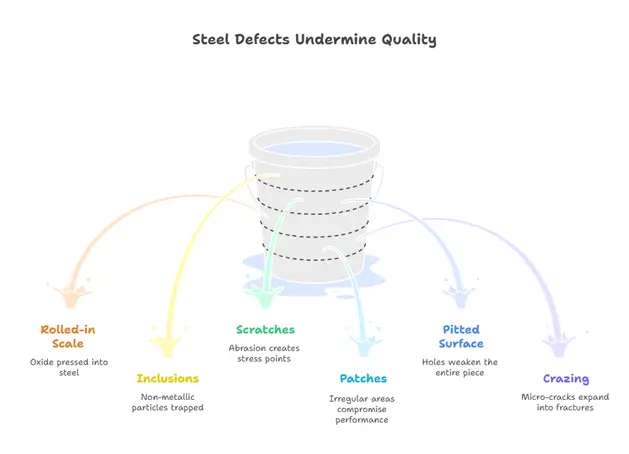
- Rolled-in Scale: This occurs when oxide scales formed during hot rolling get pressed into the steel. It’s often caused by inadequate cleaning and creates a weak point that is highly susceptible to corrosion.
- Inclusions: These are tiny non-metallic particles (like oxides or sulfides) that get trapped within the steel during its creation. They act as “weak spots” that can initiate cracks under stress.
- Scratches: Caused by mechanical abrasion during handling or processing, deep scratches aren’t just superficial. They create stress concentration points and can be the starting line for corrosion.
- Patches: These are irregular areas on the steel’s surface that look or feel different, often resulting from uneven cooling or contamination. This inconsistency can compromise the steel’s performance.
- Pitted Surface: Small holes or cavities, known as pitting, are typically caused by chemical reactions or corrosion. Over time, these pits can grow, weakening the entire piece.
- Crazing: This defect appears as a fine network of micro-cracks on the surface, often caused by thermal stress or improper cooling. These tiny cracks can easily expand into larger fractures.
While their causes vary, all six defects share a common threat: they undermine quality and safety. The core challenge for the industry is finding them all, every time, in a high-speed production environment.
The Old Way vs. The New Vision
For decades, the industry relied on traditional quality control. This meant fleets of human inspectors visually scanning products or using older methods like magnetic flux testing. These methods, while foundational, are buckling under the pressure of modern manufacturing.
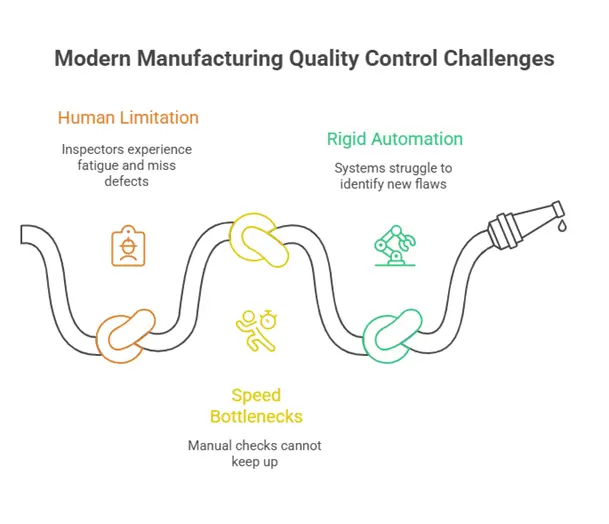
- Human Limitation: Even the most skilled inspector experiences fatigue. Spotting a hairline crack on a fast-moving steel sheet under factory lighting is like finding a needle in a haystack—while the haystack is moving. Inevitably, things get missed.
- Speed Bottlenecks: Manual checks simply cannot keep up with the speed of high-speed production lines, forcing a choice between speed and thoroughness.
- Rigid Automation: Older rule-based automated systems are often “brittle.” They struggle to identify subtle flaws or new types of defects they weren’t explicitly programmed to find.
This is where AI-powered machine vision creates a paradigm shift. It doesn’t just “see” defects; it understands them. Trained on thousands of images, an AI model learns to recognize subtle patterns and anomalies invisible to the human eye. It can adapt to new defect types, operate 24/7 without fatigue, and capture details at resolutions and speeds far beyond human capability.
This technology transforms quality assurance from a final “check” at the end of the line into a continuous, real-time process integrated directly into production, catching errors the instant they happen.
YOLO: A Game-Changer for Real-Time Inspection
In our recent project to tackle this challenge, we implemented a system built on YOLO (You Only Look Once), a cutting-edge AI architecture celebrated for its remarkable balance of speed and accuracy.
YOLO is uniquely suited for the factory floor for several reasons:
- Lightning-Fast Processing: YOLO is designed for real-time analysis. In our tests, it processed over 70 frames per second, more than enough to keep pace with the fastest industrial production lines.
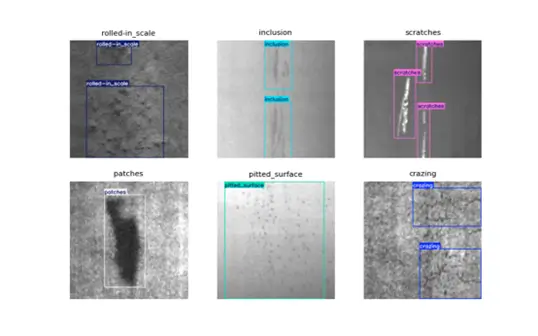
- Pinpoint Accuracy: The model doesn’t just flag a problem; it draws precise “bounding boxes” around each defect, essentially creating a real-time heatmap of cracks, pits, or inclusions on the material’s surface.
- Lightweight and Scalable: Unlike bulky, resource-heavy AI models, YOLO is efficient. This makes it easier to deploy and scale. A system trained to find defects in steel can be re-trained to inspect aluminum, copper, or other composites.
- Simultaneous Detection: YOLO’s architecture allows it to identify multiple different types of defects (e.g., a scratch and an inclusion) in a single pass, providing comprehensive quality control.
The results were impressive. The system’s scalability and versatility prove it’s a powerful tool not just for steel, but for the manufacturing industry.
Beyond Detection: The Predictive Future of AI
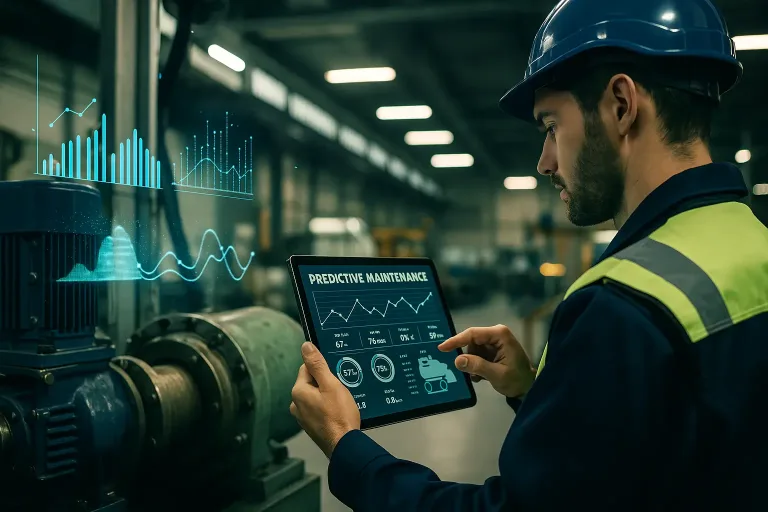
AI-powered vision is more than a simple replacement for human inspectors. It’s a new philosophy of quality. The future of this technology lies not just in finding defects, but in predicting them before they even form, using real-time data to identify machine miscalibrations or material impurities.
Imagine smart systems that don’t just flag errors but automatically self-optimize to eliminate them. For an industry built on strength and precision, AI promises a future of sharper insights, more resilient materials, and processes that are as intelligent as they are powerful.